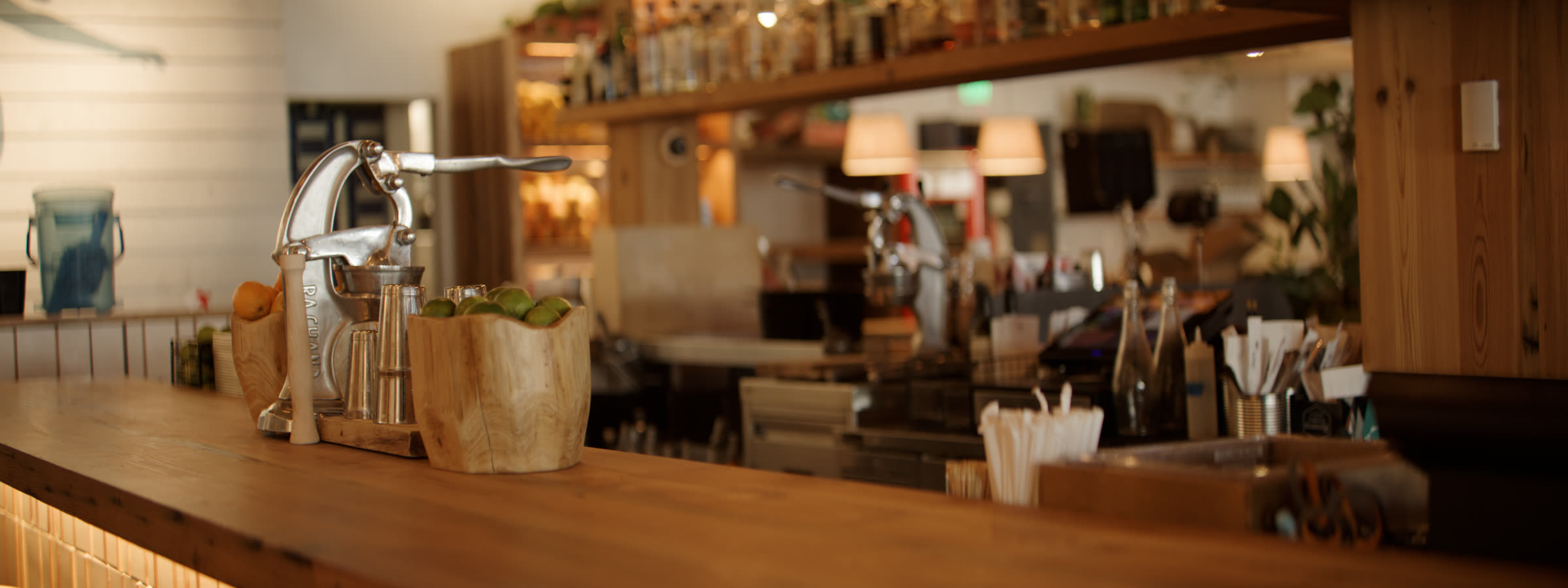
The brief from Carmella was simple: she wanted a 90-second film for the website, the kind of thing that would make someone driving past the storefront pull over.
The brief from the work itself was harder. Carmella’s Dessert Bar & Café is a small operation. The food is meticulous — handmade desserts, rotating menu, recipes she developed personally over years. Most small-business video production looks like a real-estate listing: bright, even, charm-free. The challenge was making a film whose surface texture matched the work the camera was pointing at.
The first thing we threw out
The script. Or rather, the talking-head version of the script. Carmella was happy to be on camera, and a brand-side instinct says “use the founder, viewers want to see the founder.” Sometimes that’s right. In this case, the strongest thing about Carmella’s is the food — and putting Carmella in a chef’s coat in front of a kitchen counter would have framed the film as “an interview about a café.”
Instead we shot the food, the room, and the work, in that order. Carmella appears in the film for about 12 seconds total. The rest is desserts being made, plated, eaten, talked about at the wrong volume to record.
This is a thing we end up arguing for on most small-business briefs. The owner’s instinct is “show me the founder.” The film instinct is “show me what I’m getting.” The two often disagree.
The lighting decision that changed everything
The shop has fluorescent overheads. They make every plate look 8% greener than it is, every pastry 12% flatter, every wood surface 30% colder. Most restaurant video shoots use what’s there.
We didn’t. We brought in our own lighting kit — a 4x4 Aputure Nova p600c through a softbox, one Aperture LS 600c bouncing off the back wall, three small practicals dressed into the room itself (an old reading lamp, a candle on the counter, a mid-century brass sconce we bought at a thrift store the day before).
The result on camera looks like the restaurant always looks like that. Most viewers won’t notice. The owner of the restaurant noticed, and started using the film as a reference for how she wanted to redo the actual lighting.
The food work
We shot the food on a 100mm macro at f/4 with a slider. Mistake we used to make on food shoots: zoom in tighter for the macro detail. Doesn’t work — at 100mm at f/4 the depth of field is so shallow that the focus has to land on a single line across the dish, and any deeper into the dessert and you lose detail.
The cleaner approach: pull back to a 65mm framing, get the whole dish in focus, and let the food do the work. The eye knows what cake looks like; you don’t have to count crystallized sugar grains for it to register.
We also shot every dessert plate twice — once at full frame, once at 4x cropped 4K — so the editor could push in dynamically without losing resolution. With a 6K source plate, you can punch in 200% and still cut a clean 1080p deliverable.
The 12 seconds of Carmella
What we did keep: a sequence of Carmella showing one dish to a customer, in a single take, mostly off-camera. You hear her voice describing the dessert before you see her. The edit pulls back from a close-up of the plate to reveal her hand, then her face, then the customer’s reaction — all in one slow zoom. It’s the most expensive shot in the film and it lasts 6 seconds.
She told us afterwards that’s the shot she shows people first when they ask about the film.
The lesson, restated: the founder doesn’t have to anchor the film to validate the film. Sometimes the founder shows up late in the piece and the whole thing lands harder.
The thing small-business owners get wrong
A common conversation at the start of a project like this: the owner asks how many shots, how many camera angles, how long the shoot day will be. They’re trying to figure out what they’re paying for.
The real answer is: you’re paying for the eight choices we make per minute that the camera doesn’t show.
What lens? What angle? What lighting? What color in the grade? What music? What edit pace? What’s not in the film? Every one of those is a small decision that compounds into the visible result. A cheaper production isn’t shooting a worse camera — it’s making fewer of those decisions, and the ones it does make are by reflex instead of by thought.
For a 90-second brand film, the production day was about 9 hours, of which roughly 30% was actual rolling and 70% was setting up the next shot, talking through the next decision, or standing back and looking at what we’d just got.
What Carmella did with the film
The film ran on the homepage for 18 months. The owner reported a measurable bump in catering inquiries (the business segment with the highest margin) within the first quarter — though the real win was the way she now uses the film. When someone asks her what kind of place Carmella’s is, she sends them the film instead of describing it.
That’s the test we apply to our small-business brand work. Not “did it go viral” or “what’s the view count.” But: does the owner reach for this film when someone asks them what they do?
If yes, the film earned its budget. If no, we cut something else.
If you’re a small business owner thinking about video production and worried about whether it’s worth it at your scale, the question isn’t whether it’s worth it. The question is whether the brief is right. Send us yours — we’ll tell you honestly whether what you’re describing is the kind of film that earns its budget at your size, or whether you’d be better off with something different.